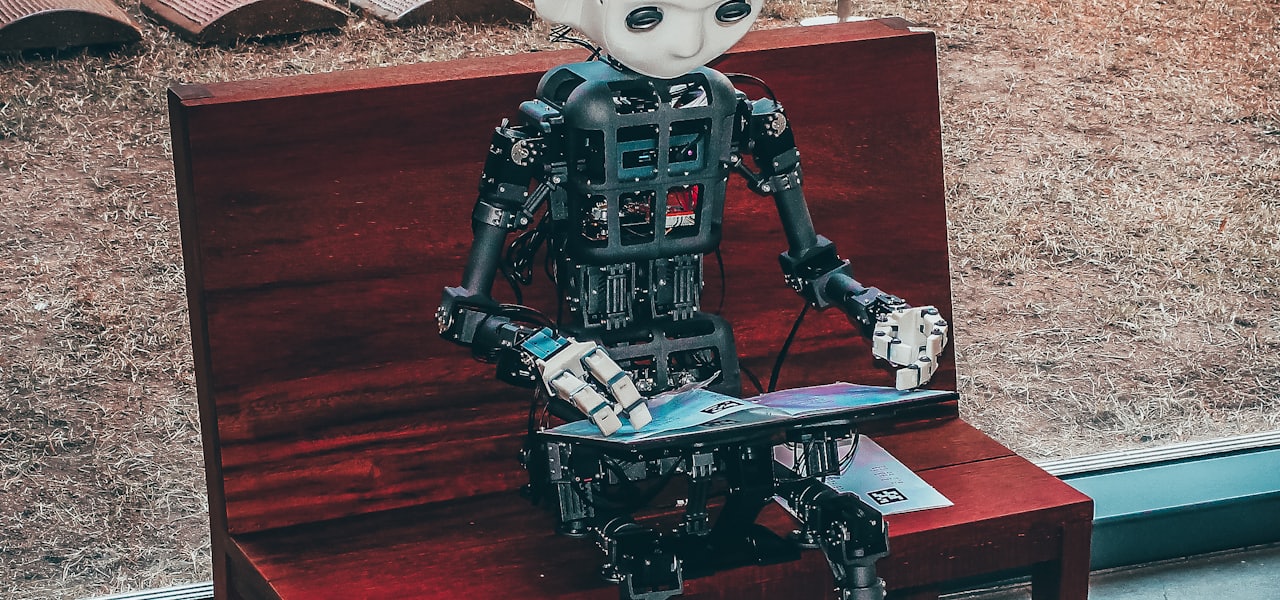
In probability theory and machine learning, the multi-armed bandit problem (sometimes called the K- or N-armed bandit problem) is named from imagining a gambler at a row of slot machines (sometimes known as "one-armed bandits"), who has to decide which machines to play, how many times to play each machine and in which order to play them, and whether to continue with the current machine or try a different machine. More generally, it is a problem in which a decision maker iteratively selects one of multiple fixed choices (i.e., arms or actions) when the properties of each choice are only partially known at the time of allocation, and may become better understood as time passes. A fundamental aspect of bandit problems is that choosing an arm does not affect the properties of the arm or other arms. Instances of the multi-armed bandit problem include the task of iteratively allocating a fixed, limited set of resources between competing (alternative) choices in a way that minimizes the regret. A notable alternative setup for the multi-armed bandit problem includes the "best arm identification (BAI)" problem where the goal is instead to identify the best choice by the end of a finite number of rounds. The multi-armed bandit problem is a classic reinforcement learning problem that exemplifies the exploration–exploitation tradeoff dilemma. In contrast to general reinforcement learning, the selected actions in bandit problems do not affect the reward distribution of the arms. The multi-armed bandit problem also falls into the broad category of stochastic scheduling. In the problem, each machine provides a random reward from a probability distribution specific to that machine, that is not known a priori. The objective of the gambler is to maximize the sum of rewards earned through a sequence of lever pulls. The crucial tradeoff the gambler faces at each trial is between "exploitation" of the machine that has the highest expected payoff and "exploration" to get more information about the expected payoffs of the other machines. The trade-off between exploration and exploitation is also faced in machine learning. In practice, multi-armed bandits have been used to model problems such as managing research projects in a large organization, like a science foundation or a pharmaceutical company. In early versions of the problem, the gambler begins with no initial knowledge about the machines. Herbert Robbins in 1952, realizing the importance of the problem, constructed convergent population selection strategies in "some aspects of the sequential design of experiments". A theorem, the Gittins index, first published by John C. Gittins, gives an optimal policy for maximizing the expected discounted reward. == Empirical motivation == The multi-armed bandit problem models an agent that simultaneously attempts to acquire new knowledge (called "exploration") and optimize their decisions based on existing knowledge (called "exploitation"). The agent attempts to balance these competing tasks in order to maximize their total value over the period of time considered. There are many practical applications of the bandit model, for example: clinical trials investigating the effects of different experimental treatments while minimizing patient losses, adaptive routing efforts for minimizing delays in a network, financial portfolio design In these practical examples, the problem requires balancing reward maximization based on the knowledge already acquired with attempting new actions to further increase knowledge. This is known as the exploitation vs. exploration tradeoff in machine learning. The model has also been used to control dynamic allocation of resources to different projects, answering the question of which project to work on, given uncertainty about the difficulty and payoff of each possibility. Originally considered by Allied scientists in World War II, it proved so intractable that, according to Peter Whittle, the problem was proposed to be dropped over Germany so that German scientists could also waste their time on it. The version of the problem now commonly analyzed was formulated by Herbert Robbins in 1952. == The multi-armed bandit model == The multi-armed bandit (short: bandit or MAB) can be seen as a set of real distributions B = { R 1 , … , R K } {\displaystyle B=\{R_{1},\dots ,R_{K}\}} , each distribution being associated with the rewards delivered by one of the K ∈ N + {\displaystyle K\in \mathbb {N} ^{+}} levers. Let μ 1 , … , μ K {\displaystyle \mu _{1},\dots ,\mu _{K}} be the mean values associated with these reward distributions. The gambler iteratively plays one lever per round and observes the associated reward. The objective is to maximize the sum of the collected rewards. The horizon H {\displaystyle H} is the number of rounds that remain to be played. The bandit problem is formally equivalent to a one-state Markov decision process. The regret ρ {\displaystyle \rho } after T {\displaystyle T} rounds is defined as the expected difference between the reward sum associated with an optimal strategy and the sum of the collected rewards: ρ = T μ ∗ − ∑ t = 1 T r ^ t {\displaystyle \rho =T\mu ^{}-\sum _{t=1}^{T}{\widehat {r}}_{t}} , where μ ∗ {\displaystyle \mu ^{}} is the maximal reward mean, μ ∗ = max k { μ k } {\displaystyle \mu ^{}=\max _{k}\{\mu _{k}\}} , and r ^ t {\displaystyle {\widehat {r}}_{t}} is the reward in round t {\displaystyle t} . A zero-regret strategy is a strategy whose average regret per round ρ / T {\displaystyle \rho /T} tends to zero with probability 1 when the number of played rounds tends to infinity. Intuitively, zero-regret strategies are guaranteed to converge to a (not necessarily unique) optimal strategy if enough rounds are played. == Variations == A common formulation is the Binary multi-armed bandit or Bernoulli multi-armed bandit, which issues a reward of one with probability p {\displaystyle p} , and otherwise a reward of zero. Another formulation of the multi-armed bandit has each arm representing an independent Markov machine. Each time a particular arm is played, the state of that machine advances to a new one, chosen according to the Markov state evolution probabilities. There is a reward depending on the current state of the machine. In a generalization called the "restless bandit problem", the states of non-played arms can also evolve over time. There has also been discussion of systems where the number of choices (about which arm to play) increases over time. Computer science researchers have studied multi-armed bandits under worst-case assumptions, obtaining algorithms to minimize regret in both finite and infinite (asymptotic) time horizons for both stochastic and non-stochastic arm payoffs. === Best arm identification === An important variation of the classical regret minimization problem in multi-armed bandits is best arm identification (BAI), also known as pure exploration. This problem is crucial in various applications, including clinical trials, adaptive routing, recommendation systems, and A/B testing. In BAI, the objective is to identify the arm having the highest expected reward. An algorithm in this setting is characterized by a sampling rule, a decision rule, and a stopping rule, described as follows: Sampling rule: ( a t ) t ≥ 1 {\displaystyle (a_{t})_{t\geq 1}} is a sequence of actions at each time step Stopping rule: τ {\displaystyle \tau } is a (random) stopping time which suggests when to stop collecting samples Decision rule: a ^ τ {\displaystyle {\hat {a}}_{\tau }} is a guess on the best arm based on the data collected up to time τ {\displaystyle \tau } There are two predominant settings in BAI: Fixed budget setting: Given a time horizon T ≥ 1 {\displaystyle T\geq 1} , the objective is to identify the arm with the highest expected reward a ⋆ ∈ arg max k μ k {\displaystyle a^{\star }\in \arg \max _{k}\mu _{k}} minimizing probability of error δ {\displaystyle \delta } . Fixed confidence setting: Given a confidence level δ ∈ ( 0 , 1 ) {\displaystyle \delta \in (0,1)} , the objective is to identify the arm with the highest expected reward a ⋆ ∈ arg max k μ k {\displaystyle a^{\star }\in \arg \max _{k}\mu _{k}} with the least possible amount of trials and with probability of error P ( a ^ τ ≠ a ⋆ ) ≤ δ {\displaystyle \mathbb {P} ({\hat {a}}_{\tau }\neq a^{\star })\leq \delta } . For example using a decision rule, we could use m 1 {\displaystyle m_{1}} where m {\displaystyle m} is the machine no.1 (you can use a different variable respectively) and 1 {\displaystyle 1} is the amount for each time an attempt is made at pulling the lever, where ∫ ∑ m 1 , m 2 , ( . . . ) = M {\displaystyle \int \sum m_{1},m_{2},(...)=M} , identify M {\displaystyle M} as the sum of each attempts m 1 + m 2 {\displaystyle m_{1}+m_{2}} , (...) as needed, and from there you can get a ratio, sum or mean as quantitative probability and sample your formulation for each slots. You can also do ∫ ∑ k ∝ i N − (
Syman
SYMAN is an artificial intelligence technology that uses data from social media profiles to identify trends in the job market. SYMAN is designed to organize actionable data for products and services including recruiting, human capital management, CRM, and marketing. SYMAN was developed with a $21 million series B financing round secured by Identified, which was led by VantagePoint Capital Partners and Capricorn Investment Group.
IDN Times
IDN Times is a digital multi-platform media outlet that provides news and entertainment for Millennials and Gen Z in Indonesia. IDN Times is one of IDN’s business units under the Digital Media pillar, founded by Winston Utomo and William Utomo on June 8, 2014. Currently, senior journalist Uni Zulfiani Lubis serves as the Editor-in-Chief of IDN Times. == History == IDN Times was initially known as Indonesian Times, a blog featuring articles written by Winston Utomo while he was working at Google Singapore. As interest and readership grew, Indonesian Times evolved into IDN Times, a digital multi-platform media company focused on delivering relevant content for Indonesia’s younger generations. == Bureau == IDN Times has a representative bureau that has spread over 12 provinces in Indonesia: == Events == === Indonesia Millennial and Gen Z Summit === The Indonesia Millennial and Gen-Z Summit (IMGS) is an annual event organized by IDN. This event aims to empower Indonesia’s younger generations through discussions and interdisciplinary collaborations. IMGS features inspirational figures, professionals, and leaders from various fields who share insights and drive positive change. The event hosts dozens of discussion sessions in collaboration with eight prominent communities. Topics covered include politics, economics, technology, and pop culture. === Indonesia Writers Festival === The Indonesia Writers Festival is an independent writing festival organized by IDN Times. The event seeks to empower Indonesians through writing by inviting experts and literacy activists from various backgrounds. == Duniaku.com == Duniaku.com is a multi-platform digital media part of IDN Times which presents content about geek culture ranging from video games, anime, comics, films, technology and gadgets. Duniaku.com was officially launched on September 6, 2019 by the Minister of Communication and Informatics Rudiantara together with CEO of IDN Media Winston Utomo and IDN Times and Editor-in-Chief of Duniaku.com Uni Lubis. == Awards == 2019 IDN won WAN-IFRA Asia Digital Media Awards 2019 as the Best Digital Project to Engage Younger and/or Millennial Audiences for IDN Times’ #MillennialsMemilih program 2020 IDN Times (IDN Times Community) won WAN-IFRA Asia Digital Media Awards 2019 in The Best in Audience Engagement category. 2021 IDN Times journalists won awards at the Subroto Award, Ministry of Energy and Mineral Resources (ESDM) on 28 September 2021. 2024 IDN Times won WAN-IFRA event at both the Asia and Global levels in Best Use of AI in Revenue Strategy. === #Interconnected22 by Pulitzer Center === One of the IDN Times journalists, Dhana Kencana, was the speaker at the #Interconnected22 conference held from June 9 to June 10, 2022, in Washington DC, United States of America. Dhana Kencana is also a grant recipient Pulitzer Center through the Rainforest Journalism Fund (RJF) program, a funding program for journalists that makes a number of coverage of the rainforest.
Randomized benchmarking
Randomized benchmarking is an experimental method for measuring the average error rates of quantum computing hardware platforms. The protocol estimates the average error rates by implementing long sequences of randomly sampled quantum gate operations. Randomized benchmarking is the industry-standard protocol used by quantum hardware developers such as IBM and Google to test the performance of the quantum operations. The original theory of randomized benchmarking, proposed by Joseph Emerson and collaborators, considered the implementation of sequences of Haar-random operations, but this had several practical limitations. The now-standard protocol for randomized benchmarking (RB) relies on uniformly random Clifford operations, as proposed in 2006 by Dankert et al. as an application of the theory of unitary t-designs. In current usage randomized benchmarking sometimes refers to the broader family of generalizations of the 2005 protocol involving different random gate sets that can identify various features of the strength and type of errors affecting the elementary quantum gate operations. Randomized benchmarking protocols are an important means of verifying and validating quantum operations and are also routinely used for the optimization of quantum control procedures. == Overview == Randomized benchmarking offers several key advantages over alternative approaches to error characterization. For example, the number of experimental procedures required for full characterization of errors (called tomography) grows exponentially with the number of quantum bits (called qubits). This makes tomographic methods impractical for even small systems of just 3 or 4 qubits. In contrast, randomized benchmarking protocols are the only known approaches to error characterization that scale efficiently as number of qubits in the system increases. Thus RB can be applied in practice to characterize errors in arbitrarily large quantum processors. Additionally, in experimental quantum computing, procedures for state preparation and measurement (SPAM) are also error-prone, and thus quantum process tomography is unable to distinguish errors associated with gate operations from errors associated with SPAM. In contrast, RB protocols are robust to state-preparation and measurement errors Randomized benchmarking protocols estimate key features of the errors that affect a set of quantum operations by examining how the observed fidelity of the final quantum state decreases as the length of the random sequence increases. If the set of operations satisfies certain mathematical properties, such as comprising a sequence of twirls with unitary two-designs, then the measured decay can be shown to be an invariant exponential with a rate fixed uniquely by features of the error model. == History == Randomized benchmarking was proposed in Scalable noise estimation with random unitary operators, where it was shown that long sequences of quantum gates sampled uniformly at random from the Haar measure on the group SU(d) would lead to an exponential decay at a rate that was uniquely fixed by the error model. Emerson, Alicki and Zyczkowski also showed, under the assumption of gate-independent errors, that the measured decay rate is directly related to an important figure of merit, the average gate fidelity and independent of the choice of initial state and any errors in the initial state, as well as the specific random sequences of quantum gates. This protocol applied for arbitrary dimension d and an arbitrary number n of qubits, where d=2n. The SU(d) RB protocol had two important limitations that were overcome in a modified protocol proposed by Dankert et al., who proposed sampling the gate operations uniformly at random from any unitary two-design, such as the Clifford group. They proved that this would produce the same exponential decay rate as the random SU(d) version of the protocol proposed in Emerson et al.. This follows from the observation that a random sequence of gates is equivalent to an independent sequence of twirls under that group, as conjectured in and later proven in. This Clifford-group approach to Randomized Benchmarking is the now standard method for assessing error rates in quantum computers. A variation of this protocol was proposed by NIST in 2008 for the first experimental implementation of an RB-type for single qubit gates. However, the sampling of random gates in the NIST protocol was later proven not to reproduce any unitary two-design. The NIST RB protocol was later shown to also produce an exponential fidelity decay, albeit with a rate that depends on non-invariant features of the error model In recent years a rigorous theoretical framework has been developed for Clifford-group RB protocols to show that they work reliably under very broad experimental conditions. In 2011 and 2012, Magesan et al. proved that the exponential decay rate is fully robust to arbitrary state preparation and measurement errors (SPAM). They also proved a connection between the average gate fidelity and diamond norm metric of error that is relevant to the fault-tolerant threshold. They also provided evidence that the observed decay was exponential and related to the average gate fidelity even if the error model varied across the gate operations, so-called gate-dependent errors, which is the experimentally realistic situation. In 2018, Wallman and Dugas et al., showed that, despite concerns raised in, even under very strong gate-dependence errors the standard RB protocols produces an exponential decay at a rate that precisely measures the average gate-fidelity of the experimentally relevant errors. The results of Wallman. in particular proved that the RB error rate is so robust to gate-dependent errors models that it provides an extremely sensitive tool for detecting non-Markovian errors. This follows because under a standard RB experiment only non-Markovian errors (including time-dependent Markovian errors) can produce a statistically significant deviation from an exponential decay The standard RB protocol was first implemented for single qubit gate operations in 2012 at Yale on a superconducting qubit. A variation of this standard protocol that is only defined for single qubit operations was implemented by NIST in 2008 on a trapped ion. The first implementation of the standard RB protocol for two-qubit gates was performed in 2012 at NIST for a system of two trapped ions
Zero-overhead looping
In computer architecture, zero-overhead looping is a hardware feature found in some processors that enables loops to execute without the performance cost of traditional loop control instructions. Instead of software managing loop iterations, the processor's hardware handles repetition automatically, saving clock cycles and improving efficiency. This technique is commonly employed in digital signal processors (DSPs) and certain complex instruction set computer (CISC) architectures. == Background == In many instruction sets, a loop must be implemented by using instructions to increment or decrement a counter, check whether the end of the loop has been reached, and if not jump to the beginning of the loop so it can be repeated. Although this typically only represents around 3–16 bytes of space for each loop, even that small amount could be significant depending on the size of the CPU caches. More significant is that those instructions each take time to execute, time which is not spent doing useful work. The overhead of such a loop is apparent compared to a completely unrolled loop, in which the body of the loop is duplicated exactly as many times as it will execute. In that case, no space or execution time is wasted on instructions to repeat the body of the loop. However, the duplication caused by loop unrolling can significantly increase code size, and the larger size can even impact execution time due to cache misses. (For this reason, it's common to only partially unroll loops, such as transforming it into a loop which performs the work of four iterations in one step before repeating. This balances the advantages of unrolling with the overhead of repeating the loop.) Moreover, completely unrolling a loop is only possible for a limited number of loops: those whose number of iterations is known at compile time. For example, the following C code could be compiled and optimized into the following x86 assembly code: == Implementation == Processors with zero-overhead looping have machine instructions and registers to automatically repeat one or more instructions. Depending on the instructions available, these may only be suitable for count-controlled loops ("for loops") in which the number of iterations can be calculated in advance, or only for condition-controlled loops ("while loops") such as operations on null-terminated strings. === Examples === ==== PIC ==== In the PIC instruction set, the REPEAT and DO instructions implement zero-overhead loops. REPEAT only repeats a single instruction, while DO repeats a specified number of following instructions. ==== Blackfin ==== Blackfin offers two zero-overhead loops. The loops can be nested; if both hardware loops are configured with the same "loop end" address, loop 1 will behave as the inner loop and repeat, and loop 0 will behave as the outer loop and repeat only if loop 1 would not repeat. Loops are controlled using the LTx and LBx registers (x either 0 to 1) to set the top and bottom of the loop — that is, the first and last instructions to be executed, which can be the same for a loop with only one instruction — and LCx for the loop count. The loop repeats if LCx is nonzero at the end of the loop, in which case LCx is decremented. The loop registers can be set manually, but this would typically consume 6 bytes to load the registers, and 8–16 bytes to set up the values to be loaded. More common is to use the loop setup instruction (represented in assembly as either LOOP with pseudo-instruction LOOP_BEGIN and LOOP_END, or in a single line as LSETUP), which optionally initializes LCx and sets LTx and LBx to the desired values. This only requires 4–6 bytes, but can only set LTx and LBx within a limited range relative to where the loop setup instruction is located. ==== x86 ==== The x86 assembly language REP prefixes implement zero-overhead loops for a few instructions (namely MOVS/STOS/CMPS/LODS/SCAS). Depending on the prefix and the instruction, the instruction will be repeated a number of times with (E)CX holding the repeat count, or until a match (or non-match) is found with AL/AX/EAX or with DS:[(E)SI]. This can be used to implement some types of searches and operations on null-terminated strings.
List & Label
List & Label is a professional reporting tool for software developers. It provides comprehensive design, print and export functions. The software component runs on Microsoft Windows and can be implemented in desktop, cloud and web applications. List & Label can be used to create user-defined dashboards, lists, invoices, forms and labels. It supports many development environments, frameworks and programming languages such as Microsoft Visual Studio, Embarcadero RAD Studio, .NET Framework, .NET Core, ASP.NET, C++, Delphi, Java, C Sharp and some more. List & Label either retrieves data from various sources via data binding, or works database independent. Reports are designed and created in the so-called List & Label Designer and then exported into a multitude of formats like PDF, Excel, XHTML and RTF. Since version 27 a web report designer for ASP.NET MVC is available. == History == The product was first released in 1992 by combit. The current version is 30. A new major version of List & Label is released every fall, usually in October. Updates are available several times a year via Service Pack. == Features == === Report Designer === The Designer enables users to graphically layout the report. It offers report objects such as tables, charts, crosstabs, gauges, HTML, conditionally formatted text, barcodes, matrix codes, and graphics, and is extensible using third-party add-ons. User applications can interact with the report via the programmable object model of the report. The real-time preview functionality allows users to view changes instantly. Usability features include layer and appearance management, enabling conditional logic to dynamically control the visibility of objects in reports. The Designer also supports the inclusion of multiple report containers in a single project, accommodating complex layouts such as parallel tables and charts. A formula wizard and support for scripting languages such as C# facilitate advanced calculations and logic. The Designer's object model (DOM) provides developers with the ability to modify layouts and behaviors programmatically. === Web Report Designer === The web report designer works browser-based and independent from printer drivers and spoolers - that makes deployments to the cloud easier. Just like the use of the Visual Studio deployment pipeline. === Data Sources === Depending on the programming language, the product offers automatic support for data sources: Databases such as Microsoft SQL Server, Oracle, MySQL, PostgreSQL, IBM Db2, SQLite, MariaDB, MongoDB, Cosmos DB XML data, CSV Business objects Data sources that can be accessed via OLE DB, ODBC or ADO.NET LINQ data and data from web services GraphQL Additionally, the product offers support for unbound data and can be extended to support other data sources via interfaces. === Output Options === Printer Image Formats (JPEG, BMP, EMF, TIFF, PNG, SVG, HEIF, WebP) Document Formats: PDF, PDF/A, Word (DOCX), Excel (XLS), PowerPoint (PPTX) HTML, XHTML, MHTML Barcodes Plain Text, RTF, CSV, JSON XML, ZIP, Email, JSON List & Label preview file === Target Audience === List & Label can be used in Windows development environments. While it competes most notably on the Microsoft .NET platform with other products such as Crystal Reports, SQL Server Reporting Services, ActiveReports, there are few competing products for other programming languages (e.g. Progress, Alaska Xbase++, Visual DataFlex). == Awards == Reader's Choice Award 2005–2008 Stevie Awards 2021: Best Technology for Data Visualization Top 100 Publisher Award Component Source 2013-2014, 2014-2015,2016, 2018, 2019, 2020, 2021, 2022
Telecommunications device for the deaf
A telecommunications device for the deaf (TDD) is a teleprinter, an electronic device for text communication over a telephone line, that is designed for use by persons with hearing or speech difficulties. Other names for the device include teletypewriter (TTY), textphone (common in Europe), and minicom (United Kingdom). The typical TDD is a device about the size of a typewriter or laptop computer with a QWERTY keyboard and small screen that uses an LED, LCD, or VFD screen to display typed text electronically. In addition, TDDs commonly have a small spool of paper on which text is also printed – old versions of the device had only a printer and no screen. The text is transmitted live, via a telephone line, to a compatible device, i.e. one that uses a similar communication protocol. Special telephone services have been developed to carry the TDD functionality even further. In certain countries, there are systems in place so that a deaf person can communicate with a hearing person on an ordinary voice phone using a human relay operator. There are also "carry-over" services, enabling people who can hear but cannot speak ("hearing carry-over", a.k.a. "HCO"), or people who cannot hear but are able to speak ("voice carry-over", a.k.a. "VCO") to use the telephone. The term TDD is sometimes discouraged because people who are deaf are increasingly using mainstream devices and technologies to carry out most of their communication. The devices described here were developed for use on the partially-analog Public Switched Telephone Network (PSTN). They do not work well on the new internet protocol (IP) networks. Thus as society increasingly moves toward IP based telecommunication, the telecommunication devices used by people who are deaf will not be TDDs. In the US and Canada, the devices are referred to as TTYs. Teletype Corporation, of Skokie, Illinois, made page printers for text, notably for news wire services and telegrams, but these used standards different from those for deaf communication, and although in quite widespread use, were technically incompatible. Furthermore, these were sometimes referred to by the "TTY" initialism, short for "Teletype". When computers had keyboard input mechanisms and page printer output, before CRT terminals came into use, Teletypes were the most widely used devices. They were called "console typewriters". (Telex used similar equipment, but was a separate international communication network.) == History == === APCOM acoustic coupler or MODEM device === The TDD concept was developed by James C. Marsters (1924–2009), a dentist and private airplane pilot who became deaf as an infant because of scarlet fever, and Robert Weitbrecht, a deaf physicist. In 1964, Marsters, Weitbrecht and Andrew Saks, an electrical engineer and grandson of the founder of the Saks Fifth Avenue department store chain, founded APCOM (Applied Communications Corp.), located in the San Francisco Bay area, to develop the acoustic coupler, or modem; their first product was named the PhoneType. APCOM collected old teleprinter machines (TTYs) from the Department of Defense and junkyards. Acoustic couplers were cabled to TTYs enabling the AT&T standard Model 500 telephone to couple, or fit, into the rubber cups on the coupler, thus allowing the device to transmit and receive a unique sequence of tones generated by the different corresponding TTY keys. The entire configuration of teleprinter machine, acoustic coupler, and telephone set became known as the TTY. Weitbrecht invented the acoustic coupler modem in 1964. The actual mechanism for TTY communications was accomplished electro-mechanically through frequency-shift keying (FSK) allowing only half-duplex communication, where only one person at a time can transmit. === Paul Taylor TTY device === During the late 1960s, Paul Taylor combined Western Union Teletype machines with modems to create teletypewriters, known as TTYs. He distributed these early, non-portable devices to the homes of many in the deaf community in St. Louis, Missouri. He worked with others to establish a local telephone wake-up service. In the early 1970s, these small successes in St. Louis evolved into the nation's first local telephone relay system for the deaf. === Micon Industries MCM device === In 1973, the Manual Communications Module (MCM), which was the world's first electronic portable TTY allowing two-way telecommunications, premiered at the California Association of the Deaf convention in Sacramento, California. The battery-powered MCM was invented and designed by a deaf news anchor and interpreter, Kit Patrick Corson, in conjunction with Michael Cannon and physicist Art Ogawa. It was manufactured by Michael Cannon's company, Micon Industries, and initially marketed by Kit Corson's company, Silent Communications. In order to be compatible with the existing TTY network, the MCM was designed around the five-bit Baudot code established by the older TTY machines instead of the ASCII code used by computers. The MCM was an instant success with the deaf community despite the drawback of a $599 cost. Within six months there were more MCMs in use by the deaf and hard of hearing than TTY machines. After a year Micon took over the marketing of the MCM and subsequently concluded a deal with Pacific Bell (who coined the term "TDD") to purchase MCMs and rent them to deaf telephone subscribers for $30 per month. After Micon formed an alliance with APCOM, Michael Cannon (Micon), Paul Conover (Micon), and Andrea Saks (APCOM) successfully petitioned the California Public Utilities Commission (CPUC), resulting in a tariff that paid for TTY devices to be distributed free of cost to deaf persons. Micon produced over 1,000 MCMs per month, resulting in approximately 50,000 MCMs being disseminated into the deaf community. Before he left Micon in 1980, Michael Cannon developed several computer compatible variations of the MCM and a portable, battery operated printing TTY, but they were never as popular as the original MCM. Newer model TTYs could communicate with selectable codes that allow communications at a higher bit rate on those models similarly equipped. However, the lack of true computer interface functionality spelled the demise of the original TTY and its clones. During the mid-1970s, other so-called portable telephone devices were being cloned by other companies, and this was the time period when the term "TDD" began being used largely by those outside the deaf community. === Text messaging and the Def-Tone System (DTS) === This relay system became known commonly as the Def-Tone System (DTS) because the tones representing letters of the alphabet were eventually carried in tones outside the range of human hearing. Today, this is commonly called multi-tap because you press a number 1, 2 or 3 times to get a corresponding letter. In 1994 Joseph Alan Poirier, a college student-worker, recommended using the system to send texts to forklifts to improve delivery of parts to the assembly line at GM Powertrain in Toledo, Ohio, and sending a text to pagers. He recommended taking pagers to alphanumeric displays incorporating the same system in discussions with the pager supplier for Outback Steakhouse and having relays put in the forklifts to ping alert messages to the pagers used in that system. He called it text messaging, coining the phrase. It is theorized that when Toyota forklift was allegedly hired by GM for this work, one of the subcontractors, Kyocera, utilized the work for the Toyota forklift company to create text messaging for cell phones. === Marsters Award === In 2009, AT&T received the James C. Marsters Promotion Award from TDI (formerly Telecommunications for the Deaf, Inc.) for its efforts to increase accessibility to communication for people with disabilities. The award holds some irony; it was AT&T that, in the 1960s, resisted efforts to implement TTY technology, claiming it would damage its communication equipment. In 1968, the Federal Communications Commission struck down AT&T's policy and forced it to offer TTY access to its network. == Protocols == There are many different standards for TDDs and textphones. === Original 5-bit Baudot code === The original standard used by TTYs is a variant of the Baudot code. The maximum speed of this protocol is 10 characters per second. This is a half-duplex protocol, which means that only one person at a time may transmit characters. If both try to transmit at the same time, the characters will be garbled on the other end. This protocol is commonly used in the United States. This is a variant of the Baudot code, implemented as 5-bits per character transmitted asynchronously using frequency-shift key-modulation at either 45.5 or 50 baud, 1 start bit, 5 data bits, and 1.5 stop bits. Details of the protocol implementation are available in TIA-825-A and also in T-REC V.18 Annex A "5-bit operational mode". === Turbo Code === The UltraTec company implements another protocol known as Enh