AI App Video Editing

AI App Video Editing — independent reviews, comparisons, pricing and step-by-step guides on Aizhi.

  • Outline of robotics

    Outline of robotics

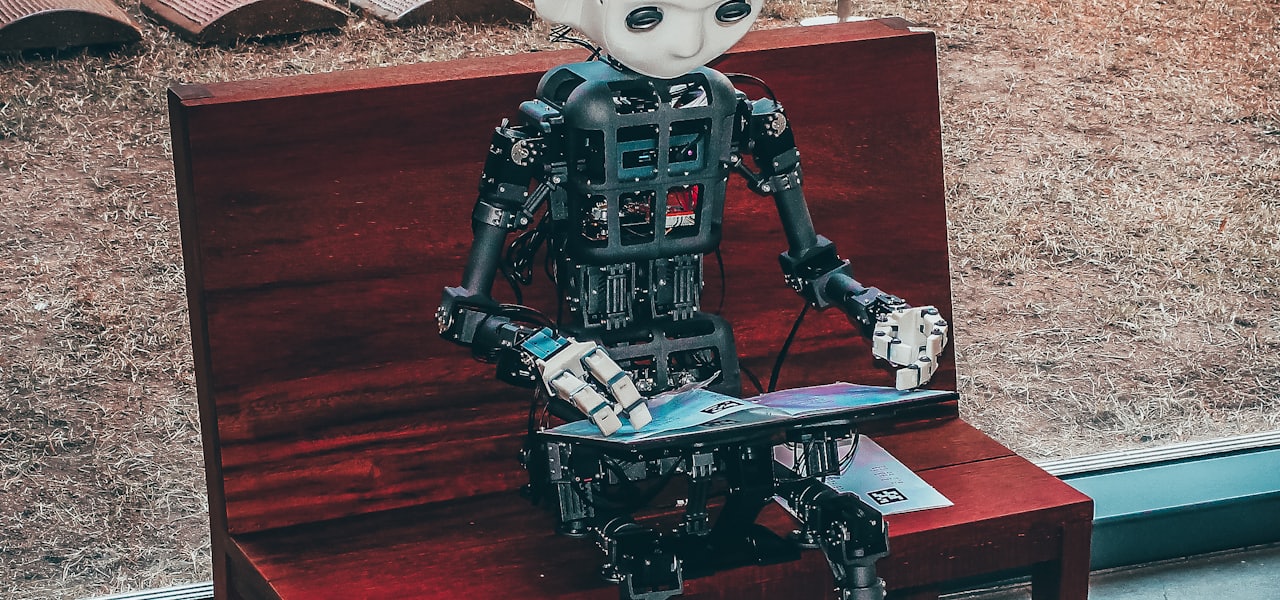
    The following outline is provided as an overview of and topical guide to robotics: Robotics is a branch of mechanical engineering, electrical engineering and computer science that deals with the design, construction, operation, and application of robots, as well as computer systems for their control, sensory feedback, and information processing. These technologies deal with automated machines that can take the place of humans in dangerous environments or manufacturing processes, or resemble humans in appearance, behaviour, and or cognition. Many of today's robots are inspired by nature contributing to the field of bio-inspired robotics. The word "robot" was introduced to the public by Czech writer Karel Čapek in his play R.U.R. (Rossum's Universal Robots), published in 1920. The term "robotics" was coined by Isaac Asimov in his 1941 science fiction short-story "Liar!" == Nature of robotics == Robotics can be described as: An applied science – scientific knowledge transferred into a physical environment. A branch of computer science – A branch of electrical engineering – A branch of mechanical engineering – Research and development – A branch of technology – == Branches of robotics == Adaptive control – control method used by a controller which must adapt to a controlled system with parameters which vary, or are initially uncertain. For example, as an aircraft flies, its mass will slowly decrease as a result of fuel consumption; a control law is needed that adapts itself to such changing conditions. Aerial robotics – development of unmanned aerial vehicles (UAVs), commonly known as drones, aircraft without a human pilot aboard. Their flight is controlled either autonomously by onboard computers or by the remote control of a pilot on the ground or in another vehicle. Android science – interdisciplinary framework for studying human interaction and cognition based on the premise that a very humanlike robot (that is, an android) can elicit human-directed social responses in human beings. Anthrobotics – science of developing and studying robots that are either entirely or in some way human-like. Artificial intelligence – the intelligence of machines and the branch of computer science that aims to create it. Artificial neural networks – a mathematical model inspired by biological neural networks. Autonomous car – an autonomous vehicle capable of fulfilling the human transportation capabilities of a traditional car Autonomous research robotics – Bayesian network – BEAM robotics – a style of robotics that primarily uses simple analogue circuits instead of a microprocessor in order to produce an unusually simple design (in comparison to traditional mobile robots) that trades flexibility for robustness and efficiency in performing the task for which it was designed. Behavior-based robotics – the branch of robotics that incorporates modular or behavior based AI (BBAI). Bio-inspired robotics – making robots that are inspired by biological systems. Biomimicry and bio-inspired design are sometimes confused. Biomimicry is copying the nature while bio-inspired design is learning from nature and making a mechanism that is simpler and more effective than the system observed in nature. Biomimetic – see Bionics. Biomorphic robotics – a sub-discipline of robotics focused upon emulating the mechanics, sensor systems, computing structures and methodologies used by animals. Bionics – also known as biomimetics, biognosis, biomimicry, or bionical creativity engineering is the application of biological methods and systems found in nature to the study and design of engineering systems and modern technology. Biorobotics – a study of how to make robots that emulate or simulate living biological organisms mechanically or even chemically. Cloud robotics – is a field of robotics that attempts to invoke cloud technologies such as cloud computing, cloud storage, and other Internet technologies centered around the benefits of converged infrastructure and shared services for robotics. Cognitive robotics – views animal cognition as a starting point for the development of robotic information processing, as opposed to more traditional Artificial Intelligence techniques. Clustering – Computational neuroscience – study of brain function in terms of the information processing properties of the structures that make up the nervous system. Robot control – a study of controlling robots Robotics conventions – Data mining Techniques – Degrees of freedom – in mechanics, the degree of freedom (DOF) of a mechanical system is the number of independent parameters that define its configuration. It is the number of parameters that determine the state of a physical system and is important to the analysis of systems of bodies in mechanical engineering, aeronautical engineering, robotics, and structural engineering. Developmental robotics – a methodology that uses metaphors from neural development and developmental psychology to develop the mind for autonomous robots Digital control – a branch of control theory that uses digital computers to act as system controllers. Digital image processing – the use of computer algorithms to perform image processing on digital images. Dimensionality reduction – the process of reducing the number of random variables under consideration, and can be divided into feature selection and feature extraction. Distributed robotics – Electronic stability control – is a computerized technology that improves the safety of a vehicle's stability by detecting and reducing loss of traction (skidding). Evolutionary computation – Evolutionary robotics – a methodology that uses evolutionary computation to develop controllers for autonomous robots Extended Kalman filter – Flexible Distribution functions – Feedback control and regulation – Human–computer interaction – a study, planning and design of the interaction between people (users) and computers Human robot interaction – a study of interactions between humans and robots Intelligent vehicle technologies – comprise electronic, electromechanical, and electromagnetic devices - usually silicon micromachined components operating in conjunction with computer controlled devices and radio transceivers to provide precision repeatability functions (such as in robotics artificial intelligence systems) emergency warning validation performance reconstruction. Computer vision – Machine vision – Kinematics – study of motion, as applied to robots. This includes both the design of linkages to perform motion, their power, control and stability; also their planning, such as choosing a sequence of movements to achieve a broader task. Laboratory robotics – the act of using robots in biology or chemistry labs Robot learning – learning to perform tasks such as obstacle avoidance, control and various other motion-related tasks Direct manipulation interface – In computer science, direct manipulation is a human–computer interaction style which involves continuous representation of objects of interest and rapid, reversible, and incremental actions and feedback. The intention is to allow a user to directly manipulate objects presented to them, using actions that correspond at least loosely to the physical world. Manifold learning – Microrobotics – a field of miniature robotics, in particular mobile robots with characteristic dimensions less than 1 mm Motion planning – (a.k.a., the "navigation problem", the "piano mover's problem") is a term used in robotics for the process of detailing a task into discrete motions. Motor control – information processing related activities carried out by the central nervous system that organize the musculoskeletal system to create coordinated movements and skilled actions. Nanorobotics – the emerging technology field creating machines or robots whose components are at or close to the scale of a nanometer (10−9 meters). Passive dynamics – refers to the dynamical behavior of actuators, robots, or organisms when not drawing energy from a supply (e.g., batteries, fuel, ATP). Programming by Demonstration – an End-user development technique for teaching a computer or a robot new behaviors by demonstrating the task to transfer directly instead of programming it through machine commands. Quantum robotics – a subfield of robotics that deals with using quantum computers to run robotics algorithms more quickly than digital computers can. Rapid prototyping – automatic construction of physical objects via additive manufacturing from virtual models in computer aided design (CAD) software, transforming them into thin, virtual, horizontal cross-sections and then producing successive layers until the items are complete. As of June 2011, used for making models, prototype parts, and production-quality parts in relatively small numbers. Reinforcement learning – an area of machine learning in computer science, concerned with how an agent ought to take actions in an environment so as to maximize some notion of cumulative reward. Robot

    Read more →
  • AI Photo Editors: Free vs Paid (2026)

    AI Photo Editors: Free vs Paid (2026)

    Trying to pick the best AI photo editor? An AI photo editor is software that uses machine learning to help you get more done — it scales effortlessly from a single task to thousands. The best picks balance beginner-friendly simplicity with the depth power users need, and they ship updates often. Whether you are a beginner or a pro, the right AI photo editor slots into your workflow and pays for itself fast. Read on for hands-on impressions, pricing tiers, and the standout features that matter.

    Read more →
  • Best AI Humanizers in 2026

    Best AI Humanizers in 2026

    Shopping for the best AI humanizer? An AI humanizer is software that uses machine learning to help you get more done — it keeps getting smarter as the underlying models improve. Pricing, accuracy, and the size of the model behind the tool are the three factors that most affect daily usefulness. Whether you are a beginner or a pro, the right AI humanizer slots into your workflow and pays for itself fast. Below we compare features, pricing, and real output so you can choose with confidence.

    Read more →
  • Markov chain geostatistics

    Markov chain geostatistics

    Markov chain geostatistics uses Markov chain spatial models, simulation algorithms and associated spatial correlation measures (e.g., transiogram) based on the Markov chain random field theory, which extends a single Markov chain into a multi-dimensional random field for geostatistical modeling. A Markov chain random field is still a single spatial Markov chain. The spatial Markov chain moves or jumps in a space and decides its state at any unobserved location through interactions with its nearest known neighbors in different directions. The data interaction process can be well explained as a local sequential Bayesian updating process within a neighborhood. Because single-step transition probability matrices are difficult to estimate from sparse sample data and are impractical in representing the complex spatial heterogeneity of states, the transiogram, which is defined as a transition probability function over the distance lag, is proposed as the accompanying spatial measure of Markov chain random fields.

    Read more →
  • Valantic

    Valantic

    Valantic GmbH (stylised as valantic) is an IT service and consulting company headquartered in Munich, Germany. == History == Valantic GmbH was founded in 2012 under the name Dabero Service Group. Until it was renamed Valantic GmbH in 2017, the company merged with IT service providers and consulting firms. These included, among others, Realtime AG, a company for SAP systems. The companies involved in these mergers were also renamed in 2017 and have since used the Valantic brand name. Realtime AG, for example, became Valantic ERP Services AG. During the COVID-19 pandemic and the resulting economic pressures, demand increased for IT service providers, particularly those offering customised software, IT consulting, SAP services, customer experience, cybersecurity, IoT, and digital work environments. In the following years, Valantic expanded by integrating additional companies. In 2021, Valantic expanded into other European countries through the integration of the Dutch company ISM eCompany and the Portuguese consulting firm Abaco. In 2022, the consulting firm C-Clear/Atom Ideas from Belgium joined Valantic. In February 2019, DPE Deutsche Private Equity Management III GmbH (DPE) took over the majority shareholding in Valantic. The founder, Holger von Daniels, and the further management retained a 25% stake. By 2025, DPE had invested €500 million in Valantic. In the following years, Valantic expanded its international locations. In 2023, Valantic incorporated the Danish company Inspari into the group, thereby entering the Scandinavian market. Inspari is a company for Microsoft technologies such as Azure and Power Platform. In the same year, Valantic joined forces with the Aiopsgroup, an international provider of online shopping applications for private and business customers of large companies. The company is based in Bulgaria with additional locations across Eastern Europe and other places. Additionally, the SAP applications division was expanded through the merger with the Spanish company Saptools. As a result, the companies became one of the largest European end-to-end consulting and implementation house for SAP services. By the end of 2023, Valantic had locations in 18 countries. In November 2024, Valantic announced its merger with the Danish digital consultancy Venzo. Through the integration of the company, founded in 2007 and oriented towards Microsoft technologies and digital transformation projects in the areas of automation, artificial intelligence, security, infrastructure and change management, Valantic further expanded its presence in Denmark and the Nordic countries. In July 2025, Valantic announced its merger with Utiligence GmbH, a Mannheim-based consulting firm for SAP technologies. Utiligence works primarily for the energy industry and supports companies in the integration of SAP S/4HANA and the digitalisation of business processes. == Company structure == Valantic is a partnership-based organisation, with partners acting as decision-makers in matters relating to corporate strategy, employee development and acquisitions. Valantic pursues a holacratic approach, promoting an open and self-organised way of working instead of hierarchical structures. By merging with other companies, Valantic is expanding its range of services and tapping into international markets and market shares. The new companies use Valantic's core systems and support processes, but usually retain their original structure. In the 2024 financial year, the company generated revenue of €544 million and employed 3,874 on average. Valantic has over 40 locations internationally. == Services == Valantic GmbH is a consulting firm, software provider and implementation partner. The company offers services in the areas of digital strategy and analytics (business intelligence and data science), customer experience management, SAP services, smart industries (Industry 4.0, supply chain management, and production planning and control processes), and financial services automation. The automation of financial services is aimed at financial service providers and banks. Valantic has been offering services in the field of generative artificial intelligence (GenAI) since 2023. Part of these services involves enabling companies to use GenAI securely and in compliance with regulations in order to make internal work processes more efficient. Its customers include large corporations, several medium-sized companies and DAX-listed companies. == Research == Since 2018, Valantic has published an annual study on the development of the SAP landscape in German-speaking countries. The study examines topics such as the migration to SAP S/4HANA, cloud strategies, technological trends and the use of artificial intelligence in business processes. The 2025 survey of 201 SAP professionals from the DACH region showed, for example, an increase in ongoing and completed S/4HANA migration projects, as well as a further shift towards private-cloud systems. The use of artificial intelligence continued to grow, as did the use of the SAP Business Technology Platform and the Business Data Cloud. In 2025, Valantic, together with the Handelsblatt Research Institute, published the trend study Digital 2030 – The Rise of Applied AI. The study was based on a survey of around 700 executives from companies in Germany, Austria, and Switzerland on the economic effects of current digitalisation trends. According to the study, most respondents consider artificial intelligence, cybersecurity, and cloud computing to hold the greatest strategic importance for business success by 2030. Around 70% of the participating companies stated that they are already achieving measurable business benefits through the use of AI applications, for example in quality control, document management, logistics, or customer service.

    Read more →
  • MemoQ

    MemoQ

    memoQ is a computer-assisted translation software suite which runs on Microsoft Windows operating systems. It is developed by the Hungarian software company memoQ Fordítástechnológiai Zrt. (memoQ Translation Technologies), formerly Kilgray, a provider of translation management software established in 2004 and cited as one of the fastest-growing companies in the translation technology sector in 2012, and 2013. memoQ provides translation memory, terminology, machine translation integration and reference information management in desktop, client/server and web application environments. == History == memoQ, a translation environment tool first released in 2006, was the first product created by memoQ Translation Technologies, a company founded in Hungary by the three language technologists Balázs Kis, István Lengyel and Gábor Ugray. In the years since the software was first presented, it has grown in popularity and is now among the most frequent TEnT applications used for translation (it was rated as the third most used CAT tool in a Proz.com study in 2013 and as the second most widely used tool in a June 2010 survey of 458 working translators), after SDL Trados, Wordfast, Déjà Vu, OmegaT and others. Today it is available in desktop versions for translators (Translator Pro edition), and project managers (Project Manager edition), as well as site-installed and hosted server applications offering integration with the desktop versions and a web browser interface. There are currently several active online forums in which users provide each other with independent advice and support on the software's functions, as well as many online tutorials created by professional trainers and active users. Before its commercial debut, a version of memoQ (2.0) was distributed as postcardware.

    Read more →
  • Top 10 AI Marketing Tools Compared (2026)

    Top 10 AI Marketing Tools Compared (2026)

    Comparing the best AI marketing tool? An AI marketing tool is software that uses machine learning to help you get more done — it lowers the barrier so anyone can produce professional output. Privacy matters too: check whether your data trains the model and whether a no-log or enterprise tier is available. Whether you are a beginner or a pro, the right AI marketing tool slots into your workflow and pays for itself fast. We tested the leading options and ranked them by quality, value, and ease of use.

    Read more →
  • The Best Free AI Copywriting Tool for Beginners

    The Best Free AI Copywriting Tool for Beginners

    Curious about the best AI copywriting tool? An AI copywriting tool is software that uses machine learning to help you get more done — it combines speed, accuracy, and an interface that just works. Hands-on testing shows real-world results vary, so a short free trial is the smartest way to decide. Whether you are a beginner or a pro, the right AI copywriting tool slots into your workflow and pays for itself fast. This guide breaks down the top picks, their pros and cons, and who each one is best for.

    Read more →
  • FastTrack Automation Studio

    FastTrack Automation Studio

    FastTrack Automation Studio (formerly known as FastTrack Scripting Host), often referred to as just FastTrack, is a scripting language for Windows IT System Administrators. The product’s goal is to handle any kind of scripting that might be required to automate processes with Microsoft Windows networks. == Manufacturer == FastTrack is produced by FastTrack Software, which is headquartered in Aalborg, Denmark. The product is promoted by the manufacturer as a one-stop shop for Windows script writers and its development paradigm is “one operation = one script line”. Script writers use a purpose-built editor to create scripts, inserting script lines via menus, drag’n drop, or simply typing them in. Scripts may be used out of the box, created from scratch, imported from forums or other users, or customized from product documentation. == Types of scripts == Simple scripts include: Outlook Signatures Login scripts Backup and replication scripts Inventory and asset management Automated Windows OS installation and deployment Automated application software deployment Active Directory scripts More advanced scripts include: SCCM task sequences Citrix ICA and RDP Clients built-in Deploying applications to server farms Deploying GPO MSI files SQL Server scripts == Basic structure == Under the hood, scripts comprise commands, functions, collections, and conditions. When a script is executed these components are converted into many lines of C# code, sometimes hundreds of lines, depending on the particular script operation. Scripts can be compiled into EXE files or MSI packages and treated as standalone Windows applications. == History == FastTrack Scripting Host (FastTrack) was first developed around 2006 to ease the administration burden of IT System Administrators on Windows networks. === Product idea === The idea for the product came from founder and President of FastTrack Software, Lars Pedersen, who has a background in systems administration. Previously with Telenor, Denmark’s major telephone company, Pedersen performed various roles in systems administration, programming and web development. He also worked as a consultant and developer on several major projects at various companies in Europe. Dissatisfied from his own experiences and frustrations administering Windows networks, Pederson looked for a way to make life easier for system administrators. In particular, he wanted something that could minimize the amount of time needed each day to perform routine and mundane tasks, which was a waste of time and expertise that should have been committed to other projects. === Development === Leading a small team of developers, Pedersen developed FastTrack Scripting Host to simplify and automate the routine tasks of system administrators. The resulting product is definitely a scripting language, but it can be used intuitively like a programming language, without requiring users to learn syntax or other concepts typically associated with programming languages. === Marketing === In April 2010, FastTrack Software entered into an agreement with Binary Research International Archived 2008-10-15 at the Wayback Machine, based in the city of Milwaukee, United States to market and sell the product globally. === Awards === FSH received a Windows IT Pro Community Choice award in 2012. == Versions == The first version was produced in June 2006 and contained 51 components, which are the commands, functions, conditions and collections making up FastTrack. The following table summarizes dates and components for major releases. Companies and organizations such as NOAA, Kawasaki, and Goodyear have used and implemented the FastTrack Scripting Host. == Comparison with other scripting software == FastTrack Scripting Host Kixtart PowerShell ScriptLogic VBScript

    Read more →
  • How to Choose an AI Customer-support Bot

    How to Choose an AI Customer-support Bot

    Comparing the best AI customer-support bot? An AI customer-support bot is software that uses machine learning to help you get more done — it lowers the barrier so anyone can produce professional output. Privacy matters too: check whether your data trains the model and whether a no-log or enterprise tier is available. Whether you are a beginner or a pro, the right AI customer-support bot slots into your workflow and pays for itself fast. We tested the leading options and ranked them by quality, value, and ease of use.

    Read more →
  • How to Choose an AI Art Generator

    How to Choose an AI Art Generator

    Looking for the best AI art generator? An AI art generator is software that uses machine learning to help you get more done — it can save you hours every week by automating repetitive work. Most options offer a generous free tier, with paid plans unlocking higher limits, faster processing, and team features. Whether you are a beginner or a pro, the right AI art generator slots into your workflow and pays for itself fast. Read on for hands-on impressions, pricing tiers, and the standout features that matter.

    Read more →
  • BFR algorithm

    BFR algorithm

    The BFR algorithm, named after its inventors Bradley, Fayyad and Reina, is a variant of k-means algorithm that is designed to cluster data in a high-dimensional Euclidean space. It makes a very strong assumption about the shape of clusters: they must be normally distributed about a centroid. The mean and standard deviation for a cluster may differ for different dimensions, but the dimensions must be independent. In other words, the data must take the shape of axis-aligned ellipses.

    Read more →
  • Real-Time UML

    Real-Time UML

    Real-Time UML (RTUML) refers to the application of the Unified Modelling Language (UML) for the analysis, design, and implementation of real-time and embedded systems, where timing constraints, concurrency, and resource management are critical. It extends standard UML with profiles, notations, and semantics to handle hard and soft real-time requirements, such as modelling predictable response times and fault tolerance. RTUML is not a separate language but a methodology leveraging UML diagrams (e.g., statecharts, sequence diagrams) for time-sensitive applications like automotive controls, avionics, and medical devices. The term is closely associated with Bruce Powel Douglass, who popularised it through his books and the Harmony process for embedded software development. As of 2025, RTUML remains relevant in industries requiring certified systems, though its adoption varies with agile methodologies and model-driven engineering tools. == Background == Real-Time UML emerged in the late 1990s as UML was standardized by the Object Management Group (OMG) in 1997, addressing the need for object-oriented modeling in real-time systems previously dominated by procedural languages like C. Traditional real-time development relied on "bare metal" programming or theoretical models, but RTUML introduced visual notations for object structure, behaviour, and timing. Bruce Powel Douglass’s 1999 book, Real-Time UML: Developing Efficient Objects for Embedded Systems, formalised the approach, emphasising statecharts for concurrency and timing constraints. Later editions (2004, 2006) incorporated UML 2.0 features like activity and timing diagrams, aligning with OMG’s Real-Time Profile (now part of MARTE—Modelling and Analysis of Real-Time and Embedded Systems). The Harmony process integrates RTUML with executable models for simulation and code generation. RTUML addresses hard real-time systems (e.g., strict deadlines in avionics) versus soft real-time (e.g., media streaming), using UML extensions for schedulability analysis. == Key concepts == RTUML adapts UML diagrams and techniques for real-time needs: Statecharts and Behaviour Modelling: Extended state machines model reactive behaviour, using and-states for concurrency, pseudostates for transitions, and timing constraints (e.g., {duration < 10ms}). Examples include cardiac pacemaker models. Sequence and Interaction Diagrams: Capture message timing, priorities, and resource allocation in multi-threaded systems. Architectural Patterns: Define logical and physical architectures with active objects for concurrency and patterns like observer or publisher-subscriber. Timing and Constraints: Use Object Constraint Language (OCL) for specifying deadlines and priorities. Profiles and Extensions: OMG’s UML Profile for Schedulability, Performance, and Time (SPT) and MARTE add stereotypes like RT::ActiveObject. These support iterative development, from requirements to deployment, often with tools like IBM Rhapsody or Enterprise Architect. == Applications == RTUML is used in: Embedded Systems: Modelling automotive ECUs or UAV controls. Avionics and Defence: DO-178C-compliant designs for fault tolerance. Medical Devices: Pacemakers or ventilators with precise timing. Industrial Automation: RTOS task visualisation via sequence diagrams. Tools like IBM Rhapsody support RTUML for model-based development and code generation in C/C++. == Criticism and adoption == RTUML’s complexity can overwhelm simple systems, and its use in agile environments is limited, where lightweight diagrams are preferred. Surveys indicate UML (including RTUML) is used in 30–50% of embedded projects, often for documentation rather than full model-driven engineering. It remains standard in academia and certified industries like aerospace.

    Read more →
  • Machine translation in China

    Machine translation in China

    Machine translation in China is the history of machine translation systems developed in China. China became the fourth country that began machine translation (MT) research following USA, UK, and the Soviet Union. In 1957, the Language Institute of Chinese Academy of Sciences took the initiative in Russian-Chinese MT research program and set up an MT research group. From then on the research activities were directed and applied for academic purposes in Universities. The turning point of MT systems launching initiatives in market began from 1990s. MT systems went into blossom into the market. Among these systems, there were commercialized MT systems. To be more specific, Transtar was the first commercialized MT system and has been constantly upgraded. What's more, IMC/EC MT system which was developed by Computer Institute of Chinese Academy of Sciences has further made great advancement. Meanwhile, the practical MT system MT-IT-EC specific to communication domain was also striking to notice, for it has greatly improved the efficiency and productivity in the issue of publications. Government funding is a critical component and support in the development of market-oriented machine translation in China. It is evident to see that since Chinese opened up to the outside world and joined the WTO, the vigorous import and export trade generate opportunities for machine translation to transfer technical terms of products into the readable target information. Facing the increasing demand of sophisticated state-of -the -art translation technology, the academic area including research institute and universities are even launching bachelors’ and master's programs regarding machine translation. Thus, strong evidence illustrates the promising field of machine translation in the future market of China.

    Read more →
  • Permutation automaton

    Permutation automaton

    In automata theory, a permutation automaton, or pure-group automaton, is a deterministic finite automaton such that each input symbol permutes the set of states. Formally, a deterministic finite automaton A may be defined by the tuple (Q, Σ, δ, q0, F), where Q is the set of states of the automaton, Σ is the set of input symbols, δ is the transition function that takes a state q and an input symbol x to a new state δ(q,x), q0 is the initial state of the automaton, and F is the set of accepting states (also: final states) of the automaton. A is a permutation automaton if and only if, for every two distinct states qi and qj in Q and every input symbol x in Σ, δ(qi,x) ≠ δ(qj,x). A formal language is p-regular (also: a pure-group language) if it is accepted by a permutation automaton. For example, the set of strings of even length forms a p-regular language: it may be accepted by a permutation automaton with two states in which every transition replaces one state by the other. == Applications == The pure-group languages were the first interesting family of regular languages for which the star height problem was proved to be computable. Another mathematical problem on regular languages is the separating words problem, which asks for the size of a smallest deterministic finite automaton that distinguishes between two given words of length at most n – by accepting one word and rejecting the other. The known upper bound in the general case is O ( n 2 / 5 ( log ⁡ n ) 3 / 5 ) {\displaystyle O(n^{2/5}(\log n)^{3/5})} . The problem was later studied for the restriction to permutation automata. In this case, the known upper bound changes to O ( n 1 / 2 ) {\displaystyle O(n^{1/2})} .

    Read more →